Automate Zoom webinar sign-up, reminders and follow-ups

Zoom makes it easy to set up a webinar and register attendees. Getting those registrants to actually show up, and following up in a way that turns viewers into customers, takes more than Zoom's built-in emails.
At DailyStory, we use Zoom for our webinars and rely on our Zoom integration to handle sign-ups, reminders, and follow-ups automatically. This guide walks through the same setup, from the sign-up form to separate follow-ups for attendees and no-shows.
Why automate webinar reminders?Registration happens late and attendance drops off without reminders. Webinar platform data compiled in a 2026 statistics roundup shows that about half of registrations come in the final week, roughly 15% on the day of the event, and about half of attendees watch on demand instead of live. Timed reminders and a replay follow-up capture both groups.
The complete automation at a glance
| When | Message | Channel | Goal |
|---|---|---|---|
| Immediately after sign-up | Registration confirmation with calendar details | Confirm the seat and set expectations | |
| Immediately after sign-up | New registrant alert | Slack | Keep your team informed |
| 1 day before | Reminder with topic, time, and join link | Get it on their calendar | |
| 1 hour before | Short reminder with a one-tap join link | Email or SMS | Drive live attendance |
| Within 24 hours after | Thank you, recording, and next step | Email (attendees) | Turn interest into action |
| Within 24 hours after | Sorry we missed you, plus the replay | Email (no-shows) | Recover registrants who missed it |
| About 1 week after | Final follow-up with an offer or next webinar | Convert engaged viewers |
Step 1: Connect Zoom to DailyStory
First, connect your Zoom account from Account Settings > Integrations in DailyStory and authorize the app through the Zoom App Marketplace. The integration requires a commercial Zoom account and uses Zoom's APIs to read your upcoming webinars and their registrants.
Once connected, DailyStory can register contacts for a webinar and automatically build segments of registrants, attendees, and no-shows. Those segments update as attendance status changes, which is what makes the follow-ups in Step 6 possible.
Next, create a campaign in DailyStory, such as "Webinars." The campaign holds all the emails, text messages, forms, and automations for your event. Don't have an account yet? Start a free trial and follow along.
Step 2: Create a sign-up web form
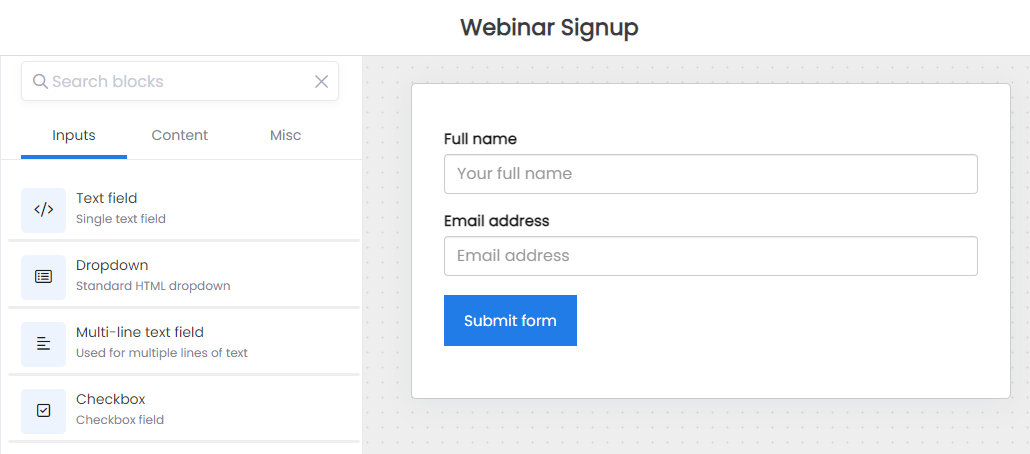
Build a short web form that asks only for what Zoom needs to register someone: first name, last name, and email. Add an optional mobile number field with a clear, unchecked opt-in if you plan to send text reminders. Fewer fields mean more sign-ups.
You can embed the form on any page, or use the WordPress integration to add it to a WordPress landing page.
Step 3: Write your reminder emails
We recommend three pre-webinar emails at a minimum. Keep them short; plain-text emails work well because they feel personal and put the join link front and center.
| Send | Include | |
|---|---|---|
| 1. Sign-up confirmation | Immediately | Thank-you, topic, date and time with time zone, an add-to-calendar link, and a note that reminders are coming |
| 2. Day-before reminder | 24 hours before | Topic, time, the join link, and one reason the session is worth attending |
| 3. Hour-before reminder | 1 hour before | The join link and start time; nothing else |
Make the join link the single, obvious call to action in every reminder. A click on that link is the best early signal of who will actually show up.
Add a text message reminder
For the hour-before reminder, consider a text message instead of, or in addition to, email. Texts get read quickly, and SMS consistently drives far higher click-through rates than email. Only text registrants who opted in, and make sure your 10DLC registration is approved. Our guide on text messaging in B2B marketing covers when SMS makes sense.
Step 4: Build the sign-up automation
Create a new automation in your campaign. You can name it anything; we use "Zoom Webinar Sign-up Drip." Then assemble it in this order:
- Trigger: Use the "Web Form submitted" trigger and select your sign-up form.
- Register in Zoom: Add the "Add to Zoom Webinar" action and choose your webinar. DailyStory uses the form data to register the contact.
- Confirm: Send the sign-up confirmation email right away, plus an optional Slack notification to your team.
- Wait: Add a delay set to "On a Specific Date and Time" for 24 hours before the webinar, then send the day-before reminder.
- Wait again: Add another specific date and time delay for 1 hour before the start, then send the hour-before email or text.
For example, for a webinar on Thursday at 12:00 PM, the first delay waits until Wednesday at 12:00 PM and the second until Thursday at 11:00 AM. Double-check the time zone on each delay so reminders land when you expect. Someone who registers after a reminder's send time simply skips that step and moves to the next one.
Step 5: Measure what's working
Track clicks, not opens. Privacy features in Apple Mail and other clients inflate open rates, and in some regions open tracking now requires separate consent. Clicks on the join link and on your post-webinar calls to action show who actually took action.
| Metric | What it tells you |
|---|---|
| Registration rate | How well your landing page and promotion convert visitors |
| Join-link click rate | Which reminder, and which channel, drives attendance |
| Live attendance rate | Attendees divided by registrants |
| Replay click rate | How many no-shows and attendees watch on demand |
| Post-webinar CTA clicks and conversions | Whether the webinar produced demos, trials, or sales |
Step 6: Automate follow-ups for attendees and no-shows
Because the Zoom integration builds attendee and no-show segments automatically, you can send each group a different follow-up. Add a delay that waits until shortly after the webinar ends, then add a condition that checks whether the contact is in the attendees segment.
| Group | Follow-up message | Call to action |
|---|---|---|
| Attended | Thank them, share the recording and slides, and highlight one key takeaway | Book a demo, start a trial, or reply with questions |
| Registered but didn't attend | "Sorry we missed you" with the replay link | Watch the replay |
| Clicked the CTA but didn't convert | A short, personal follow-up 1 to 2 days later | The same next step, with an answer to a likely objection |
| Didn't click anything | A final note about a week later | Register for your next webinar |
Send the first follow-up within 24 hours, while the session is still fresh. The clicked-but-didn't-convert group is often your warmest audience, so it's worth retargeting with a text or a personal email from the presenter. For full message templates, see our webinar email sequence guide.
Don't let the recording stop there. A webinar can become a blog post, short social clips, and a newsletter feature; see our 13 tips to repurpose content.
Setup checklist
Frequently asked questions
Do I need a paid Zoom account?
Yes. The DailyStory Zoom integration requires a commercial Zoom account with webinar capability.
How many reminders should I send?
Three is a good minimum: a confirmation, a day-before reminder, and an hour-before reminder. For webinars announced weeks in advance, add a reminder about a week out.
Should I turn off Zoom's own reminder emails?
If DailyStory is sending your reminders, consider turning off Zoom's duplicate reminder emails so registrants don't get two of each. Keep Zoom's registration confirmation if you want its personal join link included.
In conclusion
A few timed reminders and a smart follow-up turn more registrants into attendees and more attendees into customers. Once the automation is built, it runs on its own for every webinar you host.
Planning your first event? Start with our 12 expert tips to host your first webinar and our best practices for email drip campaigns. To see the Zoom integration in action, schedule a demo.